
What NATO allies think about Trump's treatment of Canada
Clip: 8/28/2026 | 5m 46sVideo has Closed Captions
What are U.S. allies thinking about Trump's treatment of Canada and South Korea?
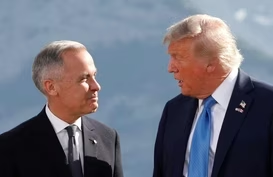
Why does President Trump loathe Canada but respect North Korea? The panel discusses what NATO members may be thinking about Trump's treatment of his supposed allies.
Problems playing video? | Closed Captioning Feedback
Problems playing video? | Closed Captioning Feedback
Major funding for “Washington Week with The Atlantic” is provided by Consumer Cellular, Otsuka, Kaiser Permanente, the Yuen Foundation, and the Corporation for Public Broadcasting.
What NATO allies think about Trump's treatment of Canada
Clip: 8/28/2026 | 5m 46sVideo has Closed Captions
Why does President Trump loathe Canada but respect North Korea? The panel discusses what NATO members may be thinking about Trump's treatment of his supposed allies.
Problems playing video? | Closed Captioning Feedback
Where to Watch Washington Week with The Atlantic
Washington Week with The Atlantic is available to stream on pbs.org and the PBS app.
Buy Now

10 big stories Washington Week covered
Washington Week came on the air February 23, 1967. In the 50 years that followed, we covered a lot of history-making events. Read up on 10 of the biggest stories Washington Week covered in its first 50 years.Providing Support for PBS.org
Learn Moreabout PBS online sponsorshipJeffrey Goldberg: There's an even broader question now.
American allies around the world are watching how he talks about South Korea.
They're watching what he said about Oman.
They're certainly watching the way he's dealing with Canada.
If you're a NATO ally at this point, in a dangerous moment in Europe, in particular, are you thinking that there's no way that Donald Trump is going to commit American forces, per Article 5 NATO Treaty to the common defense?
Idrees Kahloon: I think you are hoping that it doesn't come to that, but you have to -- and you have to hope that, you know, Mark Rutte, who has, you know, said these kind of, you know, suck up kind of messages to Trump, that kind of holds the alliance together.
But you have to be -- Jeffrey Goldberg: That's the NATO secretary general.
Idrees Kahloon: Yes, yes.
But you have to be, you have to be planning for America not to come through.
And even Carney articulated this at Davos a few months ago, right, when he talked about the plight of the middle power having to diversify away from America, that, you know, I think a lot of allies were willing, and Trump won, when he was also not behaving this aberrantly.
They were willing to think that actually America could revert to something like it had before.
The fact that, you know, it's really been the Trump era for a long time, that this has happened again, means that they have to think about alternatives.
The French, I think, are feeling quite, you know, vindicated in their skepticism of NATO.
Their -- you know, they withdrew from unified command.
They've always maintained that it's important for France to have its own nuclear power.
And now they talk about, you know, a European army.
They talk about extending a nuclear umbrella over Europe when America refuses to do that.
It's affected the world and there's no way I think even that, you know, a future president who repudiates all that Trump has done, I don't think that it snaps back at all.
Josh Wingrove: Well, just to also, you know, speak, if you don't care about Canada at all, that, you know -- that -- not accusing anyone here at the table, of course.
Jeffrey Goldberg: Yes, no.
Josh Wingrove: That's fine.
I think one thing - - an interesting lens to view this in is this deal was a referendum of sorts on whether Trump wanted to back off some of his own tariffs at a time when he's facing really bad polling and a potential midterm blow as Americans are rightfully concerned with the cost of living.
The deal as the -- what we're talking about is a deal that would have reduced tariffs on aluminum and steel.
The U.S.
gets half of its aluminum from Canada, not half of its imports, half of its total aluminum.
Steel, huge amount of steel comes from Canada, currently tariffed at 50 percent, and autos, which, of course, use a lot of aluminum and steel.
And so these are pretty core sectors to President Trump's economic agenda, and he has heaped a lot of tariff costs on them.
By the way, South Korean automakers have an advantage with a 15 percent rate and have to do none of this stuff.
And so in this deal collapsing, put aside the Canada stuff, it's been an interesting litmus test on how Trump feels about his own tariffs, how Secretary Lutnick feels.
They're not interested in watering them down very much.
Jeffrey Goldberg: Right.
I want to pivot rather wildly to the subject of Dolly Parton, which is as unifying a subject as tariffs and Donald Trump's presidency is, a divisive subject.
It's fascinating on so many levels.
I mean, obviously, in a public policy show like this, in a very polarized America, Ashley, people look at a Dolly Parton figure and say, that's one of the last things we all agreed on.
Talk for a minute about this kind of sadness about the loss of a great performer and a great humanitarian, but also this idea that, oh, all Americans like her.
Ashley Parker: Well, what was wild to me was I learned about her death in actually a meeting at The Atlantic, a politics meeting.
Someone sort of looked up from their phone and said, oh my gosh, Dolly Parton died.
And then that night at home, my family was talking at dinner, and my 15-year-old said that there was a moment they were changing classes and someone did the same thing, looked at their phone and said, oh my God, Dolly Parton died.
And there was sort of this sense of community and stunned silence, which I was just surprised by that she had so transcended not just what you're talking about, politics and partisanship, and is sort of universally beloved, but that teenagers today sort of still know her and know that role, and I thought that was so telling.
And I would be remiss if I like her music, and there's probably people at this table who know more of her music than I do, but I have three kids, two young kids, and her Imagination Library, where when you go into the hospital to give birth, you basically sign up, and your kid gets a book from Dolly Parton every single month until they turn five.
I just think it has touched so many parents in terms of literacy and introducing me to new books, too.
Jeffrey Goldberg: Right.
Idrees, I'll give you the final word because you're from Kentucky, which is near Tennessee.
Idrees Kahloon: Yes.
Jeffrey Goldberg: That's my theory.
That's my theory of the case.
But talk about her role as this kind of unifying figure.
Idrees Kahloon: Yes.
No, I mean, you know, I went to Dollywood as a kid, and I also get the Imagination Library books and that's been very telling and very good.
But, yes, I wonder, we were talking who else could fill this role, and it's hard to imagine.
But I think that, you know, she gave a lot of money also when there were floods and fires and just seemed to actually care a lot about, you know, ordinary people and never really got too involved in politics.
And I think like that was really good.
Jeffrey Goldberg: It is fascinating that you can't really name many figures like that in American life anymore, and that's probably not a good thing.
Idrees Kahloon: Yes.
Jeffrey Goldberg: But -- Josh Wingrove: He's popular globally because she represents so much of what the world believes America is and can be.
Jeffrey Goldberg: She's maybe even popular in Canada.
And on that note -- Josh Wingrove: You will never be mad with Dolly.
Jeffrey Goldberg: And then on that note, it's unfortunately all the time we have for our discussion tonight.
But I want to thank our guests for joining me, and thank you at home for watching us.
I'm Jeffrey Goldberg.
Good night from Washington.
Providing Support for PBS.org
Learn Moreabout PBS online sponsorship New Episode
- News and Public Affairs

Top journalists deliver compelling original analysis of the hour's headlines.
 New Episode
- News and Public Affairs

FRONTLINE is investigative journalism that questions, explains and changes our world.


 New Episode

 New Episode


 New Episode

Support for PBS provided by:
Major funding for “Washington Week with The Atlantic” is provided by Consumer Cellular, Otsuka, Kaiser Permanente, the Yuen Foundation, and the Corporation for Public Broadcasting.