
January 1, 2026
12/17/2025 | 55m 42sVideo has Closed Captions
Mariann Budde; Eileen Collins; Andrew Jarecki; Charlotte Kaufman
Episcopal Bishop of Washington Mariann Budde talks about finding moments of courage in a world full of fear. Space Shuttle Commander Eileen Collins discusses her amazing career, which is the subject of a new film, "Spacewoman." Andrew Jarecki and Charlotte Kaufman expose abuses inside Alabama's prison system in their film "The Alabama Solution."
Problems playing video? | Closed Captioning Feedback
Problems playing video? | Closed Captioning Feedback
January 1, 2026
12/17/2025 | 55m 42sVideo has Closed Captions
Episcopal Bishop of Washington Mariann Budde talks about finding moments of courage in a world full of fear. Space Shuttle Commander Eileen Collins discusses her amazing career, which is the subject of a new film, "Spacewoman." Andrew Jarecki and Charlotte Kaufman expose abuses inside Alabama's prison system in their film "The Alabama Solution."
Problems playing video? | Closed Captioning Feedback
How to Watch Amanpour and Company
Amanpour and Company is available to stream on pbs.org and the free PBS App, available on iPhone, Apple TV, Android TV, Android smartphones, Amazon Fire TV, Amazon Fire Tablet, Roku, Samsung Smart TV, and Vizio.
Watch Amanpour and Company on PBS
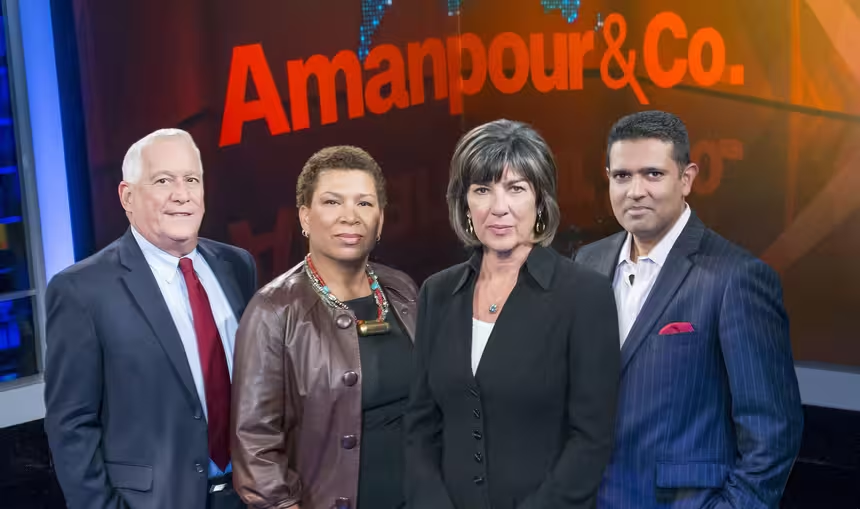
PBS and WNET, in collaboration with CNN, launched Amanpour and Company in September 2018. The series features wide-ranging, in-depth conversations with global thought leaders and cultural influencers on issues impacting the world each day, from politics, business, technology and arts, to science and sports.Providing Support for PBS.org
Learn Moreabout PBS online sponsorship(air whooshing) (upbeat music) - Hello, everyone, and welcome to Amanpour & Company.
Here's what's coming up.
- I ask you to have mercy upon the people in our country.
We're scared now.
- [Christiane] Washington Bishop Mariann Budde tells me about beseeching a president and her new book, "We Can Be Brave."
Then... - I did not wanna make a mistake because I didn't want people to say, "Oh look, the woman made a mistake."
- [Christiane] The first female space shuttle commander, I talked to Eileen Collins about shooting for the stars and making history.
Also ahead.
- How can a journalist go into a war zone, but can't go into a prison in the United States of America?
- [Christiane] A shocking expose of unchecked abuse.
The filmmakers behind the new documentary, "The Alabama Solution," tell Hari Sreenivasan about the inmates who risk their lives to reveal the truth.
(upbeat music continues) (upbeat music continues) (upbeat music fades) - [Announcer] Amanpour & Company is made possible by the Anderson Family Endowment, Jim Atwood and Leslie Williams, Candace King Weir, the Sylvia A. and Simon B. Poyta Programming Endowment to Fight Antisemitism, the Family Foundation of Leila and Mickey Straus, the Filomen M. D'Agostino Foundation, the Peter G. Peterson and Joan Ganz Cooney Fund, Charles Rosenblum, Monique Schoen Warshaw, Koo and Patricia Yuen, committed to bridging cultural differences in our communities, Barbara Hope Zuckerberg, and by contributions to your PBS station from viewers like you.
Thank you.
- Welcome to the program, everyone.
I'm Christiane Amanpour in London.
Professors and students afraid to speak freely on college campuses, federal workers afraid of losing their jobs, LGBTQ+ groups afraid of rights rollbacks, immigrants afraid of raids and mass deportations.
For many, the opening act of President Donald Trump's second term has been defined by fear, and yet people do continue taking a stand.
Nearly seven million Americans are estimated to have marched across all 50 states in October in protest.
And our first guest used her moment in the national spotlight to speak up at Washington's mighty national cathedral, Mariann Budde, the Episcopal Bishop of Washington, spoke to him, implored him from her pulpit to have mercy for those who may be frightened for the future.
Now, a book she wrote during Trump 1.0 has been adapted for younger readers, and it's called "We Can Be Brave."
She joined me from Washington to explain how she hopes they will find their own moments of courage.
Bishop Mariann Budde, welcome to our program.
- Thank you very much.
- I wanna start by asking you the obvious.
You've brought out a book several years ago and you've brought it out again for children, if I could say the children's version, "We Can Be Brave."
Tell me why you've adapted it for younger readers.
- Well, first of all, thank you.
I was thrilled to have the opportunity to adapt themes of courage for younger readers, first of all, because many of the most consequential decisions we make in life have their roots in things that happened to us when we were young and the choices that we made when we were young.
So, I wanted to underscore that for young readers, that they already have important lessons of courage in their lifetime.
I wanted to give them as many insights and lessons that I could from my own life, and more importantly, from characters and biblical and historical figures that they have known to remind them, to remind us all that courage isn't something that only brave people have, but that it's a lifelong journey of lessons and practice and efforts that we make, large and small.
- So, let me ask you then, do you think this book is a bit of a prima, I mean, can you learn, can you be taught braveness?
- Oh, absolutely, I think we all are.
I think from the moments, from our earliest steps in childhood, we are always crossing thresholds of things we've never done before.
And every time we do, we're learning something about what courage requires.
And I think we are created to do that very thing, to cross those thresholds.
And so, absolutely, it is something that we learn throughout our lives.
- So, in other words, it's not just innate, it's something that you can learn by everything you absorb and read.
- Absolutely.
- Exactly.
So, you quote Eleanor Roosevelt's definition of courage, "Doing what you think you cannot do."
- So- - Exactly.
- Did you ever do something that you thought you could not do?
- (laughs) I would say weekly I have done something I thought I couldn't do, and particularly in young adulthood, early adolescence, the things that just seemed impossible.
But you know, even in my 60s, there are times when I feel that what's being asked of me is beyond what I can do.
As a person of faith, I draw upon the spiritual reservoirs that we all have, and I wanted to lift those up as well, as well as the communal aspect of courage that it's actually a bit contagious.
We are inspired by the courage that we see in other people that give us confidence that we might be able to do something of the same.
- So, I wanna ask you this because most people know a very visible demonstration of your courage.
You may not call it courage, but some people thought it was the definition of courage when you spoke truth to power and you spoke your truth in the form of a supplication, really, to President Donald Trump just after his inaugural.
Before I play it, I just wanna know, did you define that as courageous?
- Whew.
Well, it's certainly required my willingness to step into a place of vulnerability where I could not predict or control the outcome of what I believed was mine to say in that moment.
So, in that way, I would say it did require of me courage.
- Okay, so now we're gonna play what you said from the pulpit on that day with President Trump in the front row.
And you know, it was a religious ceremony.
Here we go.
- In the name of our God, I ask you to have mercy upon the people in our country who are scared now.
There are gay, lesbian, and transgender children in Democratic, Republican, and independent families, some who fear for their lives.
I ask you to have mercy, Mr.
President, on those in our communities whose children fear that their parents will be taken away and that you help those who are fleeing war zones and persecution in their own lands to find compassion and welcome here.
- You've talked about just what it took for you to speak that truth to that power.
We now hear what you said, and that was in January.
It's now 10 months later and all that you said there actually has been actioned by President Trump and his administration, the fear amongst the gay and lesbian and transgender community, the fear amongst immigrants and children who see their parents snatched from every which way and deported, and even kids being deported.
When you said it, A, what was the reaction, and how did your congregation react to you?
- The reaction was widespread.
I think it was well known immediately afterwards that the president and his supporters were not at all pleased and thought that I had been at best, inappropriate, and worst, deeply outrageous in my remarks.
On the other side, there was a enormous outpouring of support and gratitude from around the country and around the world.
And so, it's an interesting phenomenon to be a part of something like that, but I would say that it was an opportunity for me to lift up some very basic biblical and spiritual values into that space and to honor the very people who were being and are being so dehumanized now.
And when you ask about the congregation I serve, I would say that many of the people that I serve support the positions that I've taken because they are not mine.
They are part of our broad spiritual tradition.
Others disagree.
We are not a monolithic church, but they respect my convictions and I respect those who differ with me.
- So, you're never under threat of being canceled?
- Not at the moment (chuckles).
We live in interesting times.
- We do.
You talk about a culture of contempt in the United States.
You know, for me that was quite a shocking way to put it.
I come from abroad, I've seen the great parts of the US, I came over there to make my fame and fortune or whatever you say, follow my dreams.
And you talk about, this was in a sermon this spring actually, so it is new, this.
In Germany, you said, "One of the greatest challenges in the United States today is a culture of contempt that has normalized hateful speech and encourages violence."
You've also said that we are deeply divided, the intensity of this polarization and this culture of contempt sustains a threat to destroy us.
It's actively promoted by those within and outside the United States who benefit financially and politically from our divisions.
So, it's a big thought that you are talking about.
- It's a big thing.
- Yeah, it's a big, big thing.
Tell me a bit more about the culture of contempt that you identify.
- It's not something that I, it's not a concept unique to me, but I am persuaded by virtue of what we are invited to consume through the media, through social media, through almost every messaging source that we have in this country to view those with whom we disagree through lenses of intense suspicion and even hatred.
And so, you can see the statistics that say that those of us who are on one side of a political or cultural divide see those on the other side with increasing hostility.
And we've been given license to speak to and about one another in the most extreme forms.
And I don't think there's any disputing that.
You just have to just follow any social media feed or cultural influencer to see that that's the case.
I think what's important for us as Americans to realize is that we have all been influenced by this culture.
And the language of contempt has become increasingly normalized in our daily speech.
And so, how we can, every one of us, pay attention to the ways that we speak to and about one another, and perhaps to have greater curiosity and a willingness to engage with those who see the world differently and not to allow those who put us in caricatures of difference to hold the final word.
Now, I do wanna make the distinction between the ways that many of us relate to each other in our neighborhoods and in our communities, but the public arena, and increasingly some of our private spaces are marked by greater and greater hostility.
- I guess then you must have been encouraged and actually sort of empowered when you saw two of the major world faith leaders meet together in the Vatican, in the Sistine Chapel.
- Oh, yes.
- Just recently, right?
- The American Pope Leo, Roman Catholic, and the British King Charles III, head of the Church of England, two different strains of Christianity, and they prayed together and it was the first time that the British had allowed a king or any monarch to be showed praying publicly.
Just what was that lesson?
What's the lesson to be learned?
What did you take from it?
- Well, first of all, it's a very personal connection on both sides of that.
As an American, I'm a huge admirer of Pope Leo and so grateful for his witness on the global stage, and King Charles and the Church of England, that is the tradition to which I belong in the wider Anglican communion.
And so, to see the two of them together and to know something of the backstory of how long the Anglican communion and the Roman Catholic Church have been in dialogue to work to find highest possible ground between us where we can be united in our witness to Christ and His message of love in the world, while acknowledging on so many levels, in fact, my very ordination stands in right in the middle of the differences between our traditions, and yet that didn't keep the two of them from not only speaking, but praying together.
And I might add that Anglicans and Roman Catholics pray together all the time in other contexts, right?
And I happen to be married to a Roman Catholic, so it's not that we aren't praying together, but to see the highest of leaders do so in a public way to demonstrate that common purpose, it was inspiring, it brought tears to my eye.
- And it was the first time in 500 years that these two- - 500 years.
- Yeah, yeah.
Amazing.
But it's interesting what you say because you said a little bit, you know, I'm sort of in the middle.
You are an ordained woman, the Catholics do not do that.
I wonder whether you beat up on your husband for that and try to get-- - Well, he's very much in agreement.
with the ordination of women.
- Yeah, let me end because this is a book for youngsters, and you say in your book, "Parenting was for me a masterclass in courage, not a class that I taught, but one where I was the student."
Finish that thought.
- Well, as I mentioned earlier, witnessing how very young children and then throughout adolescence and young adulthood, how our children and grandchildren cross these enormous thresholds of both physical, emotional tasks that they have never done before and how they must persevere and pick themselves up from failure and start again and learn to discern between all the voices that come at them, where truth lies for them and how the spirit that is within them comes into being and formation.
I cannot stress highly enough how significant and important it is for those of us who are elders, not only to cherish our young people, but to marvel at how they are created to do such extraordinary things in their lives and how we as the elders around them are poised to support and encourage and then allow them to take their place, their rightful place as emerging leaders among us.
- Bishop Mariann Budde, thank you very much.
I'm gonna add one word.
We can all be brave.
- Yes.
- Thank you so much.
- Indeed (chuckles).
Thank you.
- And now, from one show of courage to another, NASA is working very hard to get humans back on the moon before 2030.
The last time that happened was over 50 years ago when Eileen Collins was just a teenager in upstate New York.
She had later become the first female space shuttle commander.
Here's what she told CNN aboard her final mission, which was in 2005.
- I think it's time for us to come home, but I'm having a great time up here.
The Earth is absolutely beautiful.
We're having a great time as a crew.
We're really having the space experiences of a lifetime.
For me, we've done a little bit of everything on this flight.
I'm so happy to have done it, but it's time to come home and keep working on getting the shuttle better and ready to fly in the future, and it's time to see our families again.
- And that moment is coming.
Her incredible journey is the subject of the film "Space Woman."
Here's a clip, - Mommy, come back.
- A seven-year-old version of myself was like, "Mom is gonna die in space and I need to be ready for that."
- [Eileen] I was willing to take that risk.
Would a woman crack under pressure?
- There was a large part of the community that didn't just think she couldn't do it, but were probably actively rooting against her.
- She once told me, "We had to be better than the men to be equal."
- That's exactly what I wanna do.
- Three, two, one.
- I think until we are tested, we don't know what we're capable of.
- And we talked about her capability and all these firsts when she joined me here in the London studio.
Commander Collins, welcome to the program.
Can I ask you, you've been retired for a few years, how much did you love it, being in space?
- I loved it so much that I would go back someday, not right now because I've got a lot going on, but the feeling that you, that a human, I would say human body feels physically is so unique, I can't really compare it to anything on Earth.
The fluid shift that you get, it can be a little bit annoying the first day.
You might have a little bit of like stomach awareness.
You know, it's a little irritating when your collar's floating up around your neck and you're losing things and maybe you're bumping into your crew mates.
That's the kind of thing that a person gets over in the first couple days.
And being in space is effortless.
It can make you lazy because you're not expending a lot of energy.
You're not working against gravity like you do here on earth, so your muscles can get weak, your heart can get weak.
Your bones actually lose strength, they lose calcium.
But I think I will say the human experience of being in space is so wonderful that space tourism, I believe, will be extremely successful someday.
- Wow.
- I have no doubt.
I don't know when it will happen.
The cost has to come down and it's gotta get safer.
We've gotta fly more, but as we fly more, it gets, I wanna say something that people can afford and safe where people are willing to take the risk.
Space tourism will be huge.
- Fantastic to hear, 'cause there's so much talk about it, but as you say, it needs a little bit more work.
So, here you are, a young girl growing up in, am I getting this right?
Elmira, New York?
- Elmira, New York.
- Elmira, which was known as the sort of gliding center of the United States- - That's right.
- With these winds.
You were taken by your father to see a lot of the planes and sort of a plane spotting exercise.
And you loved it.
You decided that you loved it, but you needed to do a lot of work to get into pilot school and then astronaut school and all.
How difficult was it for you being a groundbreaking woman in this profession?
- Well, I think it's difficult on many different levels.
The first thing is financial.
So, for someone that wants to be a pilot, I mean, that costs money to take flying lessons.
So, while I was a teenager living in Elmira, I took on a lot of jobs that were not like the best jobs in the world.
I was actually a janitor, I worked at a golf course, I worked at my church, but I learned something from all of those jobs, but I also saved up my money for flying lessons.
And I think it was also difficult from the angle that there were not many women back in those days.
I didn't have a woman role model that I knew personally, so I found my role models in books.
And I remember as a kid, my mom took us to the library and I found the section on, eventually when I was older, I found the section on pilots and I read books on men and women pilots, military pilots, civilian pilots, the pilots are explorers and what they did over the history since the first flight with the Wright brothers, you know, up until rockets were invented and now we have astronauts.
And to me that was appealing.
And I think not only did I love the flying part because I found that I was pretty good at, although I wasn't good at sports, I was good at flying.
So, I enjoyed the actual flying part, but I also enjoyed, I'm going somewhere, I'm traveling, I'm exploring, and I'm going places I haven't been before.
So, I think that it was difficult, yes, but I think the joy that you get, that I got at the other end was worth the uphill climb.
- Well, it was an uphill climb, not just because of it, you know, it's a massively accomplished job, but because you were the first woman.
You were the first woman to pilot a space shuttle back in 1995, the first woman to command a space shuttle mission back in 1999.
But I wanna watch this clip about the pre-launch.
We're gonna play that and talk about what it was like getting ready.
(gentle music) - Looking at the shuttle at night, it's just an overwhelming, brilliant light.
It's one of the most incredible things that I've ever seen.
And I'm thinking, "I'm gonna launch on that thing.
Okay."
(gentle music continues) (gentle music continues) Watching the clock count down, that's when your heart starts beating.
- I'm watching you mesmerized looking at that experience from all those years ago.
Do you remember the emotions, your heart, the adrenaline?
How did you keep all of that in check?
- I would say the first thing is the training.
So, it's very important that we are not distracted by our environment because we as commander and pilot have to be ready to react to an emergency or something unusual that might happen.
If we had not trained for the loud noise, all the shaking, all the lights flashing in the window, the massive acceleration that your body is under, if you had not trained for that, you would possibly lose your ability to think straight.
So, we train, train, train.
We also practice malfunctions and running checklists in case like an engine fails or you have some kind of a leak or you have a crack in the window.
There's all kinds of things that you train for.
So, on launch day, I was actually very confident and I think I was excited more about, hey, I'm actually, I'm going up in space and I have a great mission, the mission I believe in, and I'm gonna be part of that mission and I've got a great team around me.
So, I think that's more where the excitement comes from that.
I don't think I had fear going out to launch.
I think it was more, if there was any fear, it was more like, if there's a problem, am I gonna make a mistake or am I gonna handle it like a genius that I'd like to be?
So, I think it's more along those lines.
Focus is the big thing, focus.
- Yes, you know, I was interested in part of the documentary, one of the scientists who went up with you, Mike, the British- - Mike Foale.
- Mike Foale.
- Yes.
- And he talks about how you were under essentially the microscope because you are the first woman pilot, but also how it's really, you have to be constantly concentrating, because he said even a three centimeter mistake could be the mistake between, I don't know, the rockets- - That's right.
- Disbanding or something else catastrophic falling off.
So, just, it's a lot of pressure all the time up there.
- Yeah, I think there's a lot of pressure for all the pilots, men and women.
But because I was the first woman, in fact, before I went up on my first flight, my friends, who are women pilots, you know, military and civilian, they would say to me, "Eileen, go for it.
Do it for us.
Show 'em that the women can do it."
They put more pressure on me than I would put on myself.
I did not wanna make a mistake because I didn't want people to say, "Oh look, the woman made a mistake."
I was the first and I was setting a precedent for how people would perceive women in the future and I did not wanna set a bad precedence.
I'm a swimmer, I'm a runner.
Every time I would be out there doing anything, I'd be running these malfunctions through my head and how I would handle them.
I wanted to be the hero that saved the spacecraft.
That was my motivation.
- Well, and you were the hero of all your missions.
Interesting, I think the profile on your husband is really interesting because he comes across as so supportive.
He himself was a pilot.
Tell us the story.
You never thought you were gonna get married, didn't wanna get married, and suddenly this guy turns up in, I dunno, flight suit or not, but across your desk and asked you out within the first 10 minutes.
- Well, I used to say marriage is gonna tie me down and I'm gonna not be able to go out and pursue my dreams.
Well, that's not entirely true.
If you find the right person, and Pat Youngs is my husband, who was an Air Force pilot and became an airline pilot.
He was supportive of me and as an airline pilot, he was able to follow me through my test pilot position and eventually as an astronaut because their bases can change and they can commute if they have to.
So, the fact that he was willing to do that and be with me as long as I supported his career, which is tough for the spouse of an airline pilot because they're traveling half the time and they're going through sleep shifts, and so that can be physically hard on him too.
So, I think we supported each other.
Similar careers i that we're flying, but different enough, the missions were different enough that it was interesting.
We'd come back and talk to each other about, "Hey, what happened in your training or on your flight overseas?"
It was really great and I think we support each other, it's not just one way.
And then we had the children, they came along, and so Pat was very supportive of the children when I was, well, whether I was there or not, he was a great dad for the kids.
- It is actually really nice to see all that.
Let's just put this up here now, this phone call from President Bush.
This is him in 2005, which I think was your last mission?
- Yes.
- Yes.
- Recently, as you prepare to come back, a lot of Americans will be praying for a safe return.
So, it's great talking to you.
Thanks for being such great examples of courage for a lot of our fellow citizens.
- [Eileen] Well, thank you very much, Mr.
President.
We wanna tell you that we really enjoy what we're doing.
We really believe in our mission and we believe in space exploration and getting people off the planet and seeing what's out there.
- That must have been really gratifying, especially since that was your final mission and it came after a really tricky mission, right?
When one of the, was it there was a Challenger disaster, then there was one of your own missions where the phone tiles or something came- - Right.
- So, tell me about those, 'cause you know, public does focus on that, yeah.
- Yeah, I say just in any old regular, I don't say regular, but a normal space shuttle flight, there's enough pressure on the crew.
Ours was one step higher than that in that we had just had the accident and we had lost seven crew members in that accident.
I mean, our crew was five weeks from launch when that accident happened in 2003.
And so, of course, we weren't gonna fly five weeks later.
We had to go into accident investigation.
There was so much we had to do.
And then we switched into the return to flight period, which meant there were many technical problems that had to be fixed to ensure that we didn't have that same thing that caused the accident happen to us.
Well, we thought we had fixed everything in that 2 1/2 years.
Well, we didn't.
There was something we missed.
So, on our launch, the Return to Flight Mission, we did have this foam fall off for the, I wanna say the mission that we lost that hit their heat shield.
Fortunately, the piece that fell off our flight did not hit us.
You know, I got a note one day, like, the president, President Bush would like to talk with the crew.
And I thought, "Oh no, I don't wanna mess this up.
This is really important."
So, we did the call and I was probably more nervous on that call than I was on anything else we did because we had not trained for that call with the president.
I should have anticipated it, but I was actually quite honored that he was willing to speak with us.
- I'm absolutely sure, I'm sure you were and that he recognized your groundbreaking experience there, too.
But I wanna play a clip from that mission where you were stuck up in space for a while and it was very touch and go.
- We had some repair techniques that were not well proven.
What we didn't know was whether the shuttle was capable of safe reentry, whether we could bring the crew back on Discovery or not.
They were stuck in space until we could prove the heat shield was not damaged.
- I mean, you know, I know you all are trained and you have to deal with, but you must have been thinking, "What if we never get down?
What if something terrible happens?"
I mean, the Challenger had happened also 10 years previously, just about.
- Right.
So, we had a plan in case we did have damage to our heat shield and we couldn't repair it.
Safe Haven, we called it Safe Haven, where myself and my seven crew members could stay on the Space Station.
Now, we could not have saved the shuttle, we would've had to send that back and it would burn up in the atmosphere, but my crew could have stayed on the Space Station until a rescue flew up to get us.
- One of the things that I thought was just so beautifully demonstrated in the film, and you must have just loved it when it was happening, was in the mid-90s, your first mission when you joined up with the Space Station Mir that the Russians were on.
- I want to say that Mir is very beautiful and it was very shiny and we were very happy to meet you in the sky.
- And that you had a whole sort of amazing relationship with them and greetings and exchanging gifts and cookies and sweets and things like that, trying to learn a few bits of the language.
I mean, it just seems like an eon ago that there was that kind of cooperation, and now there's no cooperation on the earth just about.
So, maybe it still exists in space, but what was it like for you?
- Yeah, so President Clinton started the Shuttle Mir program back in 1993, and then so was when we started training for it.
And then 1995 we flew our first mission.
Now, in the training, I got to know the cosmonauts.
Now, at first it was like, "Yeah, I'm former military," they were the Soviet Union.
They were like the bad guys.
Well, now the cosmonauts come to the United States and we, the astronauts, go over to Russia, and I've been twice to Russia to train.
And what I've learned is that they're just like us.
They're humans.
Yes, the culture's different, but the human nature of people, we have so many similarities, more than we have differences.
So, I became friends with many of the cosmonauts, you know, the men and the women.
Of course, I once flew with a woman cosmonaut.
And so, I've learned that we laugh together, we solve problems together, we became friends, even the flight controllers and different managers and instructors over there, we became friends.
And then you can see how quickly that can be lost when the leadership, you know, you can see the leadership of the country doesn't always reflect what the people are or what the people want.
I mean, it varies, but after Russia invaded Ukraine, we talked about should we separate the space station, the Russian component from the US, as well as the European and the Japanese component?
Well, you can't do that.
There's no technical way to do that.
So, we're still working with the Russians now, and believe it or not, we're working well at our, I wanna say the worker bee level where we have American US astronauts launching on the Soyuz, even European and Japanese astronauts, and then the Russians are launching on the SpaceX Dragon out of Florida.
So, we're still, we're moving along now.
And you know, we don't really like talk about the war that much, but we are all aware of what's happening and we just hope that it is over in a peaceful solution as quickly as possible.
- You know, you told me before we came on air that you retired as a US Air Force colonel.
You're wearing your uniform and you're proud of it.
So, I wonder what you think about the current Secretary of Defense, who's decided to call himself, I think Secretary of War, they've decided to call just unilaterally the Pentagon the Department of War or whatever it is.
But he called all these generals and commanders and admirals to DC recently, spoke about returning to a male standard in combat jobs.
Now, retired marine fighter pilot, Amy McGrath, who in Kentucky is a senate candidate, wrote on X, "This morning's grandstanding at Quantico only solidified what we already know: Pete Hegseth continues to disparage and lie about women in the military.
He claimed the military needs to, quote, 'Return to the male standard' in combat jobs of 1990.
But here's the truth, there's never been a separate male and female standard.
When women entered combat roles, one standard was set, and we've been meeting it ever since.
You can either do the job or you can't.
Period."
Your reaction?
- Yeah, there's actually, I love the question by the way.
I went through basic training, now, so I agree with what she said now, but it changes over the years.
So, when I went through basic training, it was a different standard for the women.
Now, that was 1976.
So, the men had to run a mile and a half in 12 minutes or less.
The women only had to do one and a half continuous run, and no one cared about the time.
And I said, "That's not right."
I said, "Why can't," I go, "I know the women can, I know that we, as long as we're in good shape, can do the male standard."
So, I ran with the guys, and myself and one other woman were the only two that ran with the guys.
And you know, I mean, we couldn't beat the best guy in the group, but we were still able to make the standard.
And I was trying to show the leadership, they thought they had to treat us differently, they thought that.
And so, we as the women were like, "You don't need to treat us any differently.
We're tough.
We're here because we love the mission."
We wanna be like, I wanted to be a pilot.
And in fact, the other gal that ran with me, she wanted to be a nurse, and she wanted to be a military nurse.
And so, we're like, "Yeah, we're good."
Actually, she became a doctor, but we are like, "Yeah, have us do," so I think part of it is we need to educate our leaders as to what we're capable of doing.
And I think sometimes, and I saw this in pilot training, they were trying to let the first class of women go through by, you know, let's help 'em out a little bit.
No, don't do that.
Don't help us.
Expect us to do as good as the men because we want the challenge, otherwise we wouldn't have signed up for the military.
I mean, we don't sign up for the military because it's easy.
We sign up because it's hard and we want them to push us.
So, I agree with, actually, I agree with both of them because I think eventually they're gonna come together and I think that the Secretary of Defense or Secretary of War will, as he starts watching what the women are doing, he'll come around and he'll see the attitude of the women and the tough, if you don't wanna be tough, you're not gonna join the military.
That's the way I put it.
So, kudos for both of them.
- Commander Eileen Collins, thank you very much.
- Thanks.
- Next to Alabama, a state that locks up more of its population than almost any country on earth.
That's what inspired our next guest to peek behind the curtain and through a network of prisoners willing to risk it all to expose the truth, a new documentary, "The Alabama "Solution," was born.
Here is some of the trailer.
- There's an argument that there is some systemic problem within all of our facilities, and I wholeheartedly disagree with that.
- How can you defend this?
- That one guard, he knew something, I could tell he was a liar.
- We are gonna pursue it based on the facts to the fullest extent that we're allowed.
- Their biggest fear is to see us come together on one accord.
We gotta take our power back.
We have to come together and make a stand that our life is worth something.
- [Informant] I came to prison in 1985.
I know what these folks do.
- We have been taking life and death risks to get this information out while we still can.
- To break that silence, filmmakers Andrew Jarecki and Charlotte Kaufman speak to Hari Sreenivasan about how their shocking discoveries inspired a campaign for change.
- Christiane, thanks.
Andrew Jarecki, Charlotte Kaufman, thank you both for joining us.
You recently directed a documentary called "The Alabama Solution" about the conditions inside Alabama's prison system, which houses some 20,000 individuals.
I mean, your film has incredible footage from inside, inmates who have access to cell phones, but what are the conditions there?
Because from the outside, what we see is that the state prisons are operating at nearly 200% of their capacity with just a third of the required staff.
So, what does that lead to?
- The conditions are horrible inside Alabama's prison system and they're deadly and they're brutal and they're upheld by a very corrupt administration.
These conditions have been documented in a Department of Justice report that came out in 2019, and further documentation followed up in a Department of Justice lawsuit.
But it's very hard to understand the everyday brutality and violation of constitutional rights by just reading a report.
But once you see it on the cell phone footage, there's a whole new level of understanding it on a visceral human level.
And what you see is an environment where your life is threatened every day, where you are not guaranteed medical care, where there's rampant drug use, where people are being forced to work for free, where mental health crises are being exacerbated.
And I think that what we hope the audience will take from the film is beyond what any written legal document could provide.
- We had record numbers of people leaving outta here in body bags.
They don't want the public can see what's really going on on the inside.
- How can a journalist go into a war zone, but can't go into a prison in the United States of America?
- [Informant] The state is settling one lawsuit after another.
There's no consequences for their actions.
- It's not the inmates that's killing them folks, it's the guards.
- Andrew, the cell phone footage, these are from contraband phones, right?
But how is it that so many inmates had access to cell phones and how did you get it?
- You know, I was talking to one inmate in the system and asked about how it's possible that there's so many drugs in the system and that there are so many cell phones, which was shocking to us as well.
Where are they coming from?
And he sort of looked at me incredulously and said, "You know we don't leave, right?"
And it struck me that it was clear these things were coming in, and we learned about this as we investigated, from officers and officers are operating a very lucrative trade in drugs and cell phones.
What's unique is that the cell phones, while they're prohibited allegedly by the administration, they're actually the tear in the fabric of secrecy that we were able to penetrate because of the brave efforts of these men who are inside, who are taking a tremendous risk by sharing their stories and sharing their material.
- Okay, they're gone now.
- Would a regular phone call be better?
- No, because it does not allow us to just be ourselves.
You know, when we present our stories, we wanna present our whole self, not just our voice.
- You highlight a number of individual stories in the documentary, and one of those is a man named Steven Davis who dies in prison.
It's actually through an anonymous phone call that his mother hears that her son was beaten to death.
- Okay, well, I understand.
- Who's this?
- [Caller] Well, you know, I know you're grieving and mourning, but I wanted to tell you that your son was beaten to death by an officer that was a murderer.
You know, they sweep stuff underneath the rug all the time about this.
- Tell our audience a little bit about Steven Davis and what happened to him.
- Well, like a lot of people that are incarcerated, Steven was a somewhat troubled kid, but not very different than a lot.
You know, he went through his life and ran into some problems, especially because of drug use.
And so, he was in prison under the sort of felony murder statute because he was in a car with somebody who went into a house to buy drugs and there was an altercation and that person shot someone and then came back out in the car and forced him to drive away.
So, he had never pulled the trigger.
And you know, there are many people in prison who do pull the trigger or have pulled the trigger, but he ended up in a jail where he was tased and essentially was dead for a number of minutes until he was revived.
And then after that, had more difficulty, continued to medicate himself with drugs and ended up in one of the worst prisons in Alabama.
There are 14 of those prisons, and it's clear that he got into an altercation with an officer, they will will say, "Oh, that's because he was threatening the officer."
But as we hear from the informant who calls us, he says, you know, they make things up all the time like that because they wanna be able to say that the inmate was responsible and that they had no alternative but to use deadly force, which was clearly not the case.
And we ended up having the ability to hear from a whole series of witnesses who were present at the time and said that was just a made up story.
- You should know that the state of Alabama in the case of Steven Davis says that they maintained that Officer Roderick Gadson's use of deadly force was warranted because Steven Davis refused to drop his knives.
Has anything happened to that officer since?
- This officer was, after the death of Steven Davis, promoted twice.
So, he was not disciplined, he was promoted, and then he was put in charge of the CERT team, which is the special response team that's supposed to deal with the most sensitive situations inside the prison.
- I was gonna say, I think one thing that we observed is that it seems that the administration made a calculation that one of the only ways you can run a facility that is close to 200% overcrowded with one third of the prison staff is by greenlighting brutal tactics.
But in fact, I think that brutality creates more chaos within the prison.
As our participant Robert Earl Council has said, there's the phenomena of hand me down oppression.
When you have officers constantly treating the population with violence and brutality, that creates the culture of violence throughout all of the facilities, and the culture of tension and trauma and PTSD.
So, it's really a problem that seeps through the whole system.
- It's also worth pointing out that not all prison guards are like Roderick Gadson, the man who appears to have killed Steven Davis, along with help from some others.
There are guards in our film who are extremely understanding, joined the prison system in order to make a difference, to try to do something good, to bring religion inside, to bring care inside to these men.
But when the men are dehumanized in this way, when they're brought in and treated in this way, they start to not feel like human beings, and in some ways the system attracts guards who are willing to and are encouraged to commit this kind of brutality.
- You also focus in on how this idea of human rights inside a prison has a long history going back to the Civil Rights Movement and perhaps even earlier.
And a couple of the people that you focus in on, Robert Earl Council, known as Kinetic Justice, and Melvin Ray, who after really years of suffering in solitary confinement and living in these conditions, they sort of band together and create this thing, this idea, this Free Alabama Movement.
And tell our audience a little bit about what that is and how they were able to orchestrate a statewide sort of work strike.
- Robert Earl Council, Melvin Ray, and many other men who we spoke to, but who don't appear in the film have understood for over a decade the power of the court of public opinion, and they have understood that if they can reach the public, that the public will be horrified by what's happening inside these facilities in terms of brutality, in terms of free labor, in terms of profiting off of the suffering of others.
And they have, you know, really since cell phones first appeared inside these facilities since around 2013, have been using the devices to capture their realities and share them with the public and with the press in hopes of sparking a conversation about the dire need to change how we deal with justice in this country.
And they also have always recognized the power of the, you know, the importance of the economics in this situation.
That this is a system that is profitable.
This is a system that provides great value to the state in terms of labor, $450 million a year in terms of unpaid services and labor.
And that they have the power to communicate with the outside world, and then they also have the power to, as they say, shut the system down and prevent it from profiting and hope that that will be a lever to start a real conversation about change.
- When you think about the work strike that these men have undertaken, again, it's a peaceful protest, and that's something that's so difficult to achieve in the free world, and yet these men, being restricted by tiny forms of communication, furtively being able to use cell phones to try to organize, were able to just reduce the amount of work that was happening in the prisons, and not just in the prisons.
We were really shocked to find that it's not just that Alabama is using the men to sweep the floors inside the prison, which maybe people could say, "Well, if they're incarcerated, they should do their part," but actually they're shipped out in vans every morning, they work in lots of state facilities, the governor's mansion or on road crews.
They work at the state fair, but also they're essentially leased to corporations.
So, a lot of these men who are not deemed safe enough to be released from prison are every day going to work at McDonald's or going to work at Burger King, or going to work at KFC, or going to work at the Hyundai plant or the Budweiser distributor.
They're out in the world and yet they're not considered safe enough to be given a chance to reenter society, which is why parole is so low in the state.
- You know, the Department of Justice had a multi-year investigation into this, and in the lawsuit that they filed against Alabama, they said, "The complaint alleges that the conditions at Alabama's prisons for men violate the Constitution because Alabama fails to provide adequate protection from prisoner-on-prisoner violence and prisoner-on-prisoner sexual abuse, fails to provide safe and sanitary conditions, and subjects prisoners to excessive force at the hands of prison staff."
Now, for the record, we did reach out to the Alabama Department of Corrections for comment about the conditions that your film highlights.
As we speak, we haven't heard back yet, but they did respond to Good Morning America earlier this month, and in that they said, "The Alabama Department of Corrections is aware of the film.
Production began in 2019 with footage acquired from inmate contraband cell phones.
The ADOC cannot confirm or comment on the authenticity of any video footage obtained illegally."
What kind of response has the state had, and I guess, what's your response to them?
- Well, I think the state is responding to our film in a similar way that they've responded to the Department of Justice report, which is to say, "We don't agree, we don't have a systemic issue across all our prisons and we're gonna dare defend our rights to run our prisons the way we want."
And I think, you know, they can try to say that they can't validate the footage in the film, but we made our film across six years.
And we did not just collect video footage, we also did extensive reporting through filing FOIAs, autopsies, speaking to multiple government sources, inside sources.
And we have not only investigated the deaths you see in the film, but we have also investigated all deaths that have happened within the facilities since 2019, since the release of the Department of Justice Report.
And our investigation shows that the death rate has doubled during that time, as well as the drivers, the preventable drivers of death, like drug, murder, suicide, have also increased rapidly.
So, this is a system that is still out of control and that the proposed solutions, like building new facilities, are not realizing real results.
And in fact, things have declined further.
So, it is still as urgent a situation as it was in 2019 when the Department of Justice first came in as today - I interviewed Steve Marshall, who's the attorney general of the state, and asked him if he thought that there were serious problems in the prisons.
And he said, "Well, there's this idea that we have some systemic problem in all of our prisons and I wholeheartedly disagree with that."
I think that that's in part because there's a sort of philosophy that you can act like something's not happening even if the public is asking questions.
But it just also represents the fact that these people are locked away in places that the public is not allowed to see into, right?
Journalists are not allowed to go into prisons, except very occasionally in the country, because hypothetically there are like safety considerations.
But the reality is these things are happening.
There's nothing the state can do to prevent the information from going out other than stopping the cell phones.
And in fact, that's what they're trying to do right now.
So, they're installing jammers and spending a lot of time trying to figure out how to make the information stop flowing rather than trying to improve the conditions that are obviously generating this kind of information.
- You know, I wonder when you talk about the phones, when you talk about the sort of access to information and transparency, whether this is limited to Alabama or whether this lack of accountability and insight that we have into prison systems, whether you were able to find this type of a pattern repeating in other states as well.
- I would say the conditions that allowed for the crisis in Alabama to deepen to such a severe extent exists all throughout prisons in America.
Secrecy, lack of accountability, a punitive mindset, an ability to make people work for free, that exists in all of America's facilities.
And I would say, yes, our film is about Alabama and, yes, our film is about prisons, but our film is also about what happens when a government is allowed to detain people under constrained and surveyed communication with little to no accountability.
And that's not just happening in terms of our state or federal criminal prison system, that's happening in other arenas too.
There's an urgent conversation we need to have about whether detaining people secretly and cutting them off from civil society and cutting the press off from being able to report on what's happening in institutions is compatible with the democracy.
- The HBO original documentary, "The Alabama Solution," is now available to stream on HBO Max.
And I want to thank the filmmakers, Andrew Jarecki and Charlotte Kaufman both for joining us and just for making the film.
Thank you so much.
- Thank you for watching, and thanks for sharing this with your audience.
- Yeah, thanks for having us.
- And that is it for our program tonight.
If you want to find out what's coming up on the show every night, sign up for our newsletter at pbs.org/amanpour.
Thank you for watching and goodbye from London.
(gentle music)

- News and Public Affairs

Top journalists deliver compelling original analysis of the hour's headlines.

- News and Public Affairs

FRONTLINE is investigative journalism that questions, explains and changes our world.












Support for PBS provided by: