
Player pay, transfers put college sports in new territory
Clip: 1/1/2026 | 6m 38sVideo has Closed Captions
Player pay and transfer portal put college sports in new territory
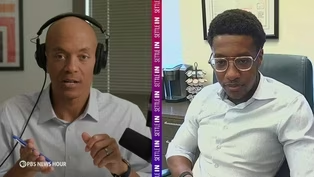
New Year’s Day has long been synonymous with college football bowl games, but it’s also a key week for the future of those teams. Starting Friday, the window opens for players to transfer, part of what some have called a “wild west” in college sports. Lisa Desjardins discussed the reshaping of college sports and what it means for athletes with Stewart Mandel.
Problems playing video? | Closed Captioning Feedback
Problems playing video? | Closed Captioning Feedback
Major corporate funding for the PBS News Hour is provided by BDO, BNSF, Consumer Cellular, American Cruise Lines, and Raymond James. Funding for the PBS NewsHour Weekend is provided by...
Player pay, transfers put college sports in new territory
Clip: 1/1/2026 | 6m 38sVideo has Closed Captions
New Year’s Day has long been synonymous with college football bowl games, but it’s also a key week for the future of those teams. Starting Friday, the window opens for players to transfer, part of what some have called a “wild west” in college sports. Lisa Desjardins discussed the reshaping of college sports and what it means for athletes with Stewart Mandel.
Problems playing video? | Closed Captioning Feedback
How to Watch PBS News Hour
PBS News Hour is available to stream on pbs.org and the free PBS App, available on iPhone, Apple TV, Android TV, Android smartphones, Amazon Fire TV, Amazon Fire Tablet, Roku, Samsung Smart TV, and Vizio.
Providing Support for PBS.org
Learn Moreabout PBS online sponsorshipLISA DESJARDINS: New Year's Day has long been synonymous with college football.
This year, that includes championship playoff games.
But it's also a key week for the future of those teams.
Starting tomorrow, the window opens for players to transfer to other schools through the so-called portal.
It's part of what some have called a Wild West in college sports, where universities can now pay players millions of dollars through a system abbreviated as NIL.
To help us understand this reshaping of college sports and what it means for athletics, I spoke recently with Stewart Mandel, editor in chief of college football coverage for "The Athletic."
Stewart Mandel, thank you for joining us.
Two things are happening right now, the name, image and likeness changes, which mean that colleges can pay athletes in some cases millions of dollars, but also the opening of the transfer portal, which is later this week.
Do we know how these two things are going to play out?
STEWART MANDEL, "The Athletic": Well, this is the first cycle since the NCAA v. House settlement that allows schools to directly pay their athletes up to $20.5 million.
And so the way it's supposed to work when the portal opens is those deals don't need to be approved by anybody.
But if you're going to offer a player an NIL deal from a third party, that is supposed to require approval from this new organization called the College Sports Commission.
But a lot of people are skeptical that that will actually work.
LISA DESJARDINS: So it seems like there's a real Wild West here.
There's a question of if these rules can be broken, who will find loopholes around these rules.
And there's also for coaches a lot of frustration.
I want to play a recent rant from the Arkansas basketball coach, John Calipari.
He's talking about all the transferring happening by these students who may transfer from school to school to school.
He uses a Northeastern word that means essentially a sham.
And here's what he said.
JOHN CALIPARI, University of Arkansas Men's Head Basketball Coach: It's fugazi, fugazi,because they're getting 400, 500, 800, a million, and they're not pros.
So now they have to go get a job after four stops.
No college degree.
LISA DESJARDINS: Fugazi, he says.
What do you see as the ups and downs for star college players from this system?
STEWART MANDEL: I get why coaches are frustrated.
They have to reset their roster every single year.
They don't know which guys they will be able to hold on to, which guys will go in the portal.
But I think coaches are consumed by basketball.
They're not necessarily following court cases.
Everything that has happened here in the last five years in terms of not just players being allowed to be paid, but players being allowed to transfer freely, has been the result of an unfavorable court decision against the NCAA.
So I get it.
I don't think it's ideal for anybody, including, as Coach Calipari mentions, the players and their education, to be able to transfer to four or five different schools over the course of their career.
But one judge in West Virginia a couple of years ago ruled that restricting the players' movement is an antitrust violation.
And so the NCAA is pretty much powerless right now to put any of those kind of rules in place.
LISA DESJARDINS: Now, one example that's been getting a lot of attention this week is Iowa State and their football team.
It does look like they're going to have a lot of players transferring and that they will be left with a smaller team at its core.
Someone who has paid attention to this is Texas Senator Ted Cruz, who posted on X that this was, in his words, a crisis.
And he also said that Congress needs to act.
What could be Congress' role here exactly?
I know there's been a lot of debate this year.
STEWART MANDEL: Well, first of all, Senator Cruz neglected to mention that Iowa State's coach left for Penn State.
So that's why a lot of players are leaving.
There is a bill that's been sitting in the House for most of this year called the SCORE Act that would give the NCAA an antitrust exemption to put in the kind of rules that these coaches want.
But it's unclear if it's ever going to come to vote.
It's been stalled several times.
If it does come to vote and it passes, obviously, it would still need to be passed in the Senate.
And I think that's where Senator Cruz comes in, because he might take the reins.
He's been very interested in this issue for a couple of years and would probably be one of the leaders to try to get it through the Senate.
Right now, it's unclear if or when it's ever going to even come up for vote in the House.
LISA DESJARDINS: The mechanics of all of this are incredibly complicated, and that's why it's a bit of a Wild West, as you're saying.
But it may be a big picture question for you.
These athletes are now potentially making millions of dollars.
That's just a few of them that are hitting that mount.
But it's not clear.
But are they really professionals now?
What's the difference between these college athletes and professionals?
STEWART MANDEL: Well, if you're basing it just on the amount of money they're making, yes, a lot of them are professionals.
But the big difference is, they do still need to go to class.
They do need to be enrolled at a school.
There are certain requirements you need to hit to be eligible to play.
And then the hot-button issue that's been going on for years is the issue of whether they should be considered employees.
They are not considered employees.
They are -- the term you always hear as student athletes.
But there is certainly pressure.
In fact, that's one of the reasons for that congressional act is to try to prevent what might be the logical next step, where the athletes become employees, they can collectively bargain.
Then, yes, it would start to very closely resemble professional athletics.
LISA DESJARDINS: How significant is this time right now for college sports?
STEWART MANDEL: Since 2021, when NIL first came into existence, these past four years, there's been more change, more fundamental change in college athletics than in the past 50 or 60 years before that.
And the scary thing is, it's still not all resolved.
There's still going to be many years ahead of kind of litigating these issues and what the future of college sports should look like.
So it's very much a national pastime in flux, right down to some of the most basic rules?
So, yes, it's a very pivotal time, especially for the commissioners and the athletic directors and the presidents, who are really -- have been really kind of putting all their eggs in Congress to bail them out of this situation.
LISA DESJARDINS: Stewart Mandel, thanks for trying to help us get our bearings.
We appreciate it.
STEWART MANDEL: Thank you.
Damola Adamolekun joins Geoff Bennett on ‘Settle In’
Video has Closed Captions
Damola Adamolekun joins Geoff Bennett for our ‘Settle In’ podcast (3m 27s)

Fire at Swiss bar during New Year's kills about 40
Video has Closed Captions
Fire at Swiss bar during New Year's celebration kills about 40 (2m 37s)

National Geographic explorer on his walk around the globe
Video has Closed Captions
National Geographic Explorer Paul Salopek on his trek around the globe on foot (7m 20s)

New class of billionaires solidifies outsized influence
Video has Closed Captions
How the new class of billionaires solidified outsized political influence (7m 26s)

What Hygge can teach Americans about comfort and happiness
Video has Closed Captions
What the Scandinavian concept of hygge can teach Americans about comfort and happiness (5m 52s)

Why it’s getting harder to find a new car under $25,000
Video has Closed Captions
Why it’s getting harder to find a new car under $25,000 (4m 51s)
Providing Support for PBS.org
Learn Moreabout PBS online sponsorship
- News and Public Affairs

FRONTLINE is investigative journalism that questions, explains and changes our world.

- News and Public Affairs

Amanpour and Company features conversations with leaders and decision makers.












Support for PBS provided by:
Major corporate funding for the PBS News Hour is provided by BDO, BNSF, Consumer Cellular, American Cruise Lines, and Raymond James. Funding for the PBS NewsHour Weekend is provided by...