
Craig Fugate joins Amna Nawaz on 'Settle In'
Clip: 8/27/2026 | 3m 13sVideo has Closed Captions
Craig Fugate and Amna Nawaz discuss climate change and disaster response on 'Settle In'
Craig Fugate led the Federal Emergency Management Agency during the Obama administration through record-breaking disaster years. On our PBS News podcast, "Settle In," Amna Nawaz spoke with Fugate about how climate change has upended disaster response, and about criticism that the agency has been politicized in recent years.
Problems playing video? | Closed Captioning Feedback
Problems playing video? | Closed Captioning Feedback
Major corporate funding for the PBS News Hour is provided by BDO, BNSF, Consumer Cellular, American Cruise Lines, and Raymond James. Funding for the PBS NewsHour Weekend is provided by...
Craig Fugate joins Amna Nawaz on 'Settle In'
Clip: 8/27/2026 | 3m 13sVideo has Closed Captions
Craig Fugate led the Federal Emergency Management Agency during the Obama administration through record-breaking disaster years. On our PBS News podcast, "Settle In," Amna Nawaz spoke with Fugate about how climate change has upended disaster response, and about criticism that the agency has been politicized in recent years.
Problems playing video? | Closed Captioning Feedback
Where to Watch PBS News Hour
PBS News Hour is available to stream on pbs.org and the PBS app.
Providing Support for PBS.org
Learn Moreabout PBS online sponsorshipAMNA NAWAZ: Craig Fugate led the Federal Emergency Management Agency during the Obama administration through record-breaking disaster years.
I spoke to him for the latest episode of our PBS News podcast "Settle In" about how climate change has upended disaster response.
Here's a clip from that conversation.
How much of the conversation inside the agency was about climate change?
Did you feel like you had to push that a little bit inside?
CRAIG FUGATE, Former Administrator, Federal Emergency Management Agency: Most of the conversations were really about we needed to mitigate the effects of climate, which that also caused a problem, because when people use the word mitigate in emergency management, that means reducing the impacts of a disaster.
What they were talking about, and this was across the administration, was reducing greenhouse gases and addressing the effects of greenhouse gases and the transition away from carbon base to an electrical base, mitigating that.
But it wasn't dealing with the disasters.
And, really, I think within the agency -- and this was something that President Obama said.
I was traveling with him up to see Governor Christie in the aftermath of Superstorm Sandy.
And, again, I need to be clear.
A singular event is not an indication that the climate's changing.
We get these types of storms.
You get these types of events.
But the president said something I really took to heart, and that was, he said: "Craig, I think the debate about climate change is over.
We need to start talking about climate adaptation."
And that immediately caused a rift within the climate community for those who felt that, if we talk about adaptation, we're giving up.
And others, that was it was merely recognizing the climate had already changed.
I think that was the thing we kept hearing was, it was going to change.
And it was like, no, it's already changed.
We're already seeing these impacts.
And we need to adapt.
Really, we were able to go back.
FEMA says, look, just building back for the past 100 years' worth of data doesn't work anymore if we're dealing with record-setting events.
How do we change our guidance so that we're not just building it back where it was, the way it was, with maybe some upgraded building codes, but really focusing on, what are the future impacts and are we really mitigating for the future, versus only looking at the past?
AMNA NAWAZ: I mean, what did you think when President Obama said that to you?
Did you agree with that?
CRAIG FUGATE: I have sat through several times when President Obama would just off the cuff say stuff, and it was just like, why didn't I think of that?
(LAUGHTER) CRAIG FUGATE: And it framed it in such a way that it got rid of all the vagueness.
We were still -- at that time, everybody was arguing about what's causing climate change, is it real?
You still had that going on.
And his position was, the debate's over.
We're seeing the impacts.
We need to be talking about adaptation.
And, for FEMA, that meant that, because we spend a lot of your tax dollars rebuilding infrastructure, buildings and stuff, after disasters, particularly in these floods and other things, we needed to look at what we could do differently to address the future risks, not just the current risks.
AMNA NAWAZ: And you can watch our full conversation and all episodes of "Settle In" on our PBS News YouTube page or wherever you get your podcasts.

Gaza's youth search for hope in devastated homeland
Video has Closed Captions
Gaza's traumatized youth search for glimmers of hope in devastated homeland (6m 45s)

How Mayo Clinic is using improv to engage dementia patients
Video has Closed Captions
How the Mayo Clinic is using improv to engage dementia patients (7m 13s)
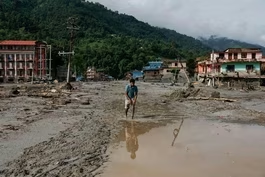
How melting glaciers contributed to Himalayas flooding
Video has Closed Captions
How melting glaciers contributed to the flooding disaster in the Himalayas (8m 34s)

The issue the Lindsay Clancy jury will be deliberating
Video has Closed Captions
The central issue that the Lindsay Clancy jury will be deliberating (7m 7s)
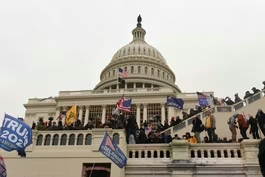
Jan. 6 rioters pursue new path for payments from Trump
Video has Closed Captions
Jan. 6 rioters pursue new path for payments from Trump administration (5m 4s)
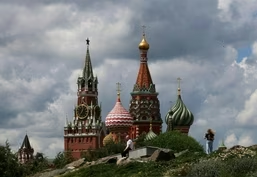
Latvia's foreign minister warns of Russian sabotage acts
Video has Closed Captions
Latvia's foreign minister warns of Russian sabotage acts in Europe (7m 24s)
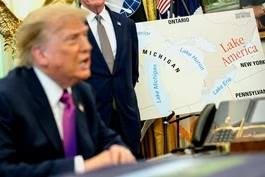
News Wrap: Trump signs order to rename Lake Ontario
Video has Closed Captions
News Wrap: Trump signs order to rename Lake Ontario as Lake America (7m 3s)
Providing Support for PBS.org
Learn Moreabout PBS online sponsorship New Episode
- News and Public Affairs

Today's top journalists discuss Washington's current political events and public affairs.
 New Episode
- News and Public Affairs

FRONTLINE is investigative journalism that questions, explains and changes our world.


 New Episode


 New Episode
 New Episode

 New Episode
 New Episode
Support for PBS provided by:
Major corporate funding for the PBS News Hour is provided by BDO, BNSF, Consumer Cellular, American Cruise Lines, and Raymond James. Funding for the PBS NewsHour Weekend is provided by...