
The Afro-Mexpats
Special | 16m 40sVideo has Closed Captions
A growing movement of Black Americans are moving to Mexico, hoping to find refuge from racism.
A growing movement of Black Americans are moving to Mexico, hoping to find refuge from racism. Through interviews with three “Mexpats,” this film explores how they are navigating questions of race, language and color in their new country, as well as accusations of gentrification.
Problems playing video? | Closed Captioning Feedback
Problems playing video? | Closed Captioning Feedback
The Afro-Mexpats
Special | 16m 40sVideo has Closed Captions
A growing movement of Black Americans are moving to Mexico, hoping to find refuge from racism. Through interviews with three “Mexpats,” this film explores how they are navigating questions of race, language and color in their new country, as well as accusations of gentrification.
Problems playing video? | Closed Captioning Feedback
Where to Watch VOCES
VOCES is available to stream on pbs.org and the PBS app.
Buy Now
Providing Support for PBS.org
Learn Moreabout PBS online sponsorshipMore from This Collection
The new season of VOCES SHORTS blends documentary and narrative filmmaking to introduce audiences to compelling characters and communities rarely centered on screen. In honor of Hispanic Heritage Month, VOCES SHORTS gives rising filmmakers a national platform for cinematic storytelling while helping their work reach new viewers and illuminating the breadth of the contemporary Latino experience.
 New
NewVideo has Closed Captions
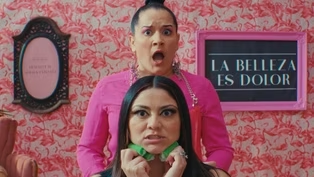
It’s just another day in Mari’s salon until Christina comes in late with a truly terrible dye job. (6m 16s)
Video has Closed Captions
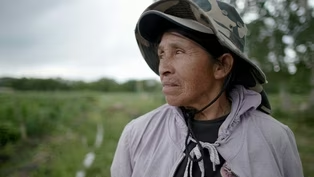
A Mayan elder reflects on her migrant story and the skies that tie her to home. (12m 43s)
Video has Closed Captions
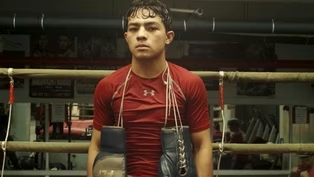
Andy Dominguez, an immigrant boxer from Mexico, tries to make his mark in the boxing world. (20m 46s)
Providing Support for PBS.org
Learn Moreabout PBS online sponsorship[intro music plays] It can be complicated to be a Black American living in Mexico.
In my case, I feel the benefits of being a U.S.
citizen.
But at the same time, even though I'm also Mexican-American I'm always seen as an outsider.
When I arrived here six years ago, it was rare to see people who looked like me.
But I've seen a change.
There are more of us here.
[deejay music plays] Check, check hello.
Transmitiendo desde la Colonia San Rafael.
Hello.
This is Combahee Collection Radio on Radio Nopal.
I am deejay Black Daria y tenemos un programa muy chingon hoy.
[deejay music plays] I'm originally from Portland, Oregon, and I've been in Mexico City for almost two and a half years.
People are very welcoming, very curious, Just like, want to know where I'm from, why I'm here.
[laughs] And people are always almost 100% surprised when I say that I'm Mexican.
I am grateful that, luckily enough, I could get my dual citizenship because my mom was born in Mexico City.
She grew up in Iztapalapa and my dad was born and raised in Portland, Oregon.
A lot of my family and my mom's side was like, “¿por qué estás en México?” Like they just did not get it.
Portland, like at one point was one of the whitest cities in the US.
Everyone always asked me, "how did it... what was it like growing up in Portland, Oregon, as like a Black Mexican girl?"
But I didn't know any different.
Honestly, since the pandemic, like there are a lot more foreigners here.
So it's a little more normalized now to look like, "not-Mexican" and live here.
[sound of waves] Being a girl, and a Black girl.
I was always defined by what I could not do.
Every time somebody told me I could not do something, I tried to do it ¡Que la paz prevalezca en Guerrero!
¡Que la paz prevalezca en Guerrero!
Y que la paz prevalezca en nuestros corazones.
¡Que la paz prevalezca en nuestros corazones!
¡Felicidades!
I was born in 1951, in Detroit, Michigan, when we still had Apartheid, still had segregation.
Once you have experienced a greater level of freedom here, I'm defined by what I can do, not what I cannot do.
I wanted to do my graduate work and research and decided, well Mexico And I got a plane ticket to go to Acapulco.
And that was the year that we had Hurricane Paulina.
[sound of waves] And the plane turned around and came to Zihuatanejo.
I said Z-what?
I had never heard of Zihuatanejo.
And Acapulco and Zihuatanejo were landing ports for Africans coming into Mexico.
I didn't know that when I came here.
I learned that from being here.
Because I've worked through the peace program, I've interacted with many different groups.
And so over the years, bit by bit, I got to know the, most of the community.
And this is home now.
Almost 30 years.
- Hi, Mommy.
- Mommy, I cant see you.
- Hi.
- Hi Mommy.
- I miss you.
- I miss you too.
- Why?
Why you don't call me for a long time?
She's right here.
- Hey Tali.
- Get your hand out your mouth, girl.
I can't hear you.
[Tali begins to cry] - Oh, Mommy.
[inaudible crying] It's okay.
Mommy is going to fly to Dallas and pick you up like Mommy always does every year.
You know, we always get on the airplane together.
And we're going to come back to Mexico together.
Mommy, it's okay.
[playing and screaming] I am originally born in San Diego.
I was looking for a place to stay in San Diego, but everywhere was too expensive.
But I kept seeing all these places in Mexico that were pretty cheap.
It was like middle of COVID.
And I told my partner, I was like, we should just move to Mexico.
[family laughing] What do you mean?
That's my baby.
That's my dad, I've known him for longer [dog running and barking] Our daughters, we send them back to America for school just because it's like a little bit easier for us that way Crossing into America just thinking about it gives me anxiety.
I have to worry about police.
I have to worry about being a Black person in general in America.
Where here it's like, I don't have to worry about a lot of things.
We have like, this routine that, if we're going to cross going out to San Diego, we wake up at three in the morning.
He, like, works with his hands.
So he has a cross into America.
He hates it.
He hates that he has to cross every day.
He hates the lines.
We can afford to live here in Mexico.
We can afford to live here comfortably.
So it's like a give and take.
I think it's been harder to integrate into Mexico because one, no one thinks I'm Mexican.
So they assume that I am a foreigner, which I am.
¿Creen que nos dejen tomar una foto con ustedes?
- Sí.
Feeling othered in Mexico is a real thing that happens almost every day.
I used to say, like, "buenos días, buen día" to people on the street, but like a lot of people would not say it back to me.
It just happens like every single day.
Like it's just like a mosquito bite constantly.
I'm always going to be seen as a foreigner just because I navigate the world as a Black woman, even if I am Mexican.
[food sizzling] Ive been stared at before, but I have always took it as curiosity because there's not a lot of Black people in the area that are not Haitian or Jamaican.
Y flor y champiñon.
I've had instances where we've had people like, come up to my daughters and want to take pictures with them.
And always wanting to touch my hair.
They don't know that it's a no, no, don't touch me.
[laughs] But that's just like a little bit of a culture difference.
And I don't find it to be... Personally, I don't find it to be a bad thing because there's a lot about Mexican culture that I don't know.
And I know people are trying to understand, like, why is an American moving here?
- This is guacamole.
- Sí ¿Cómo está?
- Muy bien, que gusto verte de nuevo, mi querida hermana.
¿Todo bien en casa?
- Todo bien.
Well, I became a Mexican citizen in 2018, so that allows me to be politically active.
Then I was able to reach out and to start going to the Encuentros de los Pueblos Negros.
¿Cómo está chico?
I see the Afro-Mexican movement to be very similar to the civil rights movement in the United States that happened during the 1960s.
Le solidarité.
Sí, es mi T-shirt.
When you have an experience like that, it shows the actual connection between our peoples.
[home deejay music plays] My community here is definitely like a few different bubbles.
I definitely feel like I'm stuck a little bit.
Some days, not always, some days in an expat bubble where I'm like, did I even speak any Spanish today?
[background jazz music plays] There's a lot of discourse in the WhatsApp group chats about gentrification.
I do feel like Black Americans are very aware of it just because of the history of Black Americans, you know?
Even if you are Black American, you, you have a privilege.
Like people tell me for my apartment, "Oh, that's cheap."
When my Mexican friends are like, "That's so much money.” “I can't believe you pay that much."
The American presence has raised the cost of living here for Mexicans in Mexico.
You know, the locals are kind of upset at us, but we aren't, you know, asking to be paying these prices.
This is another capitalistic country.
And so just like America is a greedy, capitalistic country, San Diego is doing the same thing to Americans.
I'm just trying to live.
Majority of us, especially Black Americans.
We are just trying to live.
[street music plays] I also acknowledge the frustration of Afro-Mexicans because they're probably the most marginalized people in this country of all the people.
[street music continues to play] Technically, by definition, I moved here out of privilege, and because I can, which would make me an expat.
But that word in itself: Expatriate.
It kind of means that I was once a patriot to America.
And um, as a Black person, the majority of us are not necessarily patriot.
It's really an escape.
It's escape from being treated as a second-class citizen in a different country.
I think we keep coming to Mexico, as you said, to find a refuge.
For me, it was getting out of the segregation and apartheid and not having to go back and deal with it anymore.
According to Travel magazine, the largest growing segment of Americans coming to Mexico are African Americans.
[greeting and laughing] We see a lot of Black expat groups.
But does that mean it excludes the Black Indigenous people?
We have to be careful of that.
Our whole movement has been for inclusion.
I say it with love, I'm glad you're here.
But the newbies have to immerse into the community, learn the language, and begin to get involved.
[background music with horn plays] Recently, I threw my first party, uh in Mexico City.
It was all Black women, or Afro-Latino, or queer DJs.
I already have a community, but I would love to grow my community even more.
I would love to be more intentional about being in like, Mexican spaces, speaking more Spanish.
I always had a goal that I wanted to speak to my abuela in Spanish.
I'm grateful I was able to do that before she passed away.
En la tierra y en el mar Mexico is more of a "we" culture.
Americans are a "me" culture.
I consider myself a scout, a pathfinder.
I hope I've opened up some doors for other folks to come.
[piano music plays] But we must come with respect, with recognition, with retribution, with reciprocity.
"It was in Mexico that I stopped feeling invisible."
These are the words of Audre Lorde.
And they ring true for me.
Our skin color makes us feel hypervisible.
But at the same time, Mexico is a place where many of us come to feel truly seen.
More than 11,000 Black people born in the U.S.
now live in Mexico.
And as more of us continue to move here, I wonder.
What role will our community play in this country?
And will we find our place in this place that we now call home?
[closing music plays]












Support for PBS provided by: