
Bassoonist Eleni Katz | CHASING CRESCENDOS
Special | 11m 11sVideo has Closed Captions
Bassoonist Eleni Katz shares a glimpse of her musical journey at New World Symphony.
From the careful preparation of her reeds to long rehearsals, bassoonist Eleni Katz shares a glimpse of her musical journey. Born to a family of artists in Wisconsin, she began playing clarinet until her teacher suggested she tried bassoon as a way to stand out. Now, she is tasked with blending in with the New World Symphony orchestra as they take on Tchaikovsky's Symphony No. 5 in E minor.
Problems playing video? | Closed Captioning Feedback
Problems playing video? | Closed Captioning Feedback
Major series funding for GREAT PERFORMANCES is provided by The Joseph & Robert Cornell Memorial Foundation, the Anna-Maria and Stephen Kellen Arts Fund, the LuEsther T. Mertz Charitable Trust, Sue...
Bassoonist Eleni Katz | CHASING CRESCENDOS
Special | 11m 11sVideo has Closed Captions
From the careful preparation of her reeds to long rehearsals, bassoonist Eleni Katz shares a glimpse of her musical journey. Born to a family of artists in Wisconsin, she began playing clarinet until her teacher suggested she tried bassoon as a way to stand out. Now, she is tasked with blending in with the New World Symphony orchestra as they take on Tchaikovsky's Symphony No. 5 in E minor.
Problems playing video? | Closed Captioning Feedback
How to Watch Great Performances
Great Performances is available to stream on pbs.org and the free PBS App, available on iPhone, Apple TV, Android TV, Android smartphones, Amazon Fire TV, Amazon Fire Tablet, Roku, Samsung Smart TV, and Vizio.
Buy Now
Great Performances Newsletter
Subscribe to the Great Performances newsletter to keep up with the latest full episodes to stream, exclusive content, and more!Providing Support for PBS.org
Learn Moreabout PBS online sponsorshipMore from This Collection
Explore the preparation and processes of New World Symphony’s young musicians in Miami as they work alongside soloists, conductors and mentors to prepare for live concerts and train for professional orchestral positions in this new digital series from Great Performances on PBS.
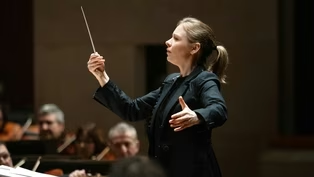
Conductor Gemma New | CHASING CRESCENDOS
Video has Closed Captions
Conductor Gemma New leads the orchestra with a focus on creating a collective musical experience. (11m 25s)
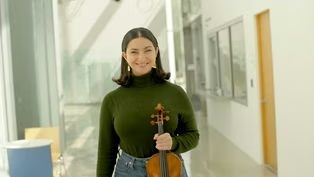
Violinist Allison Taylor | CHASING CRESCENDOS
Video has Closed Captions
Violinist Allison Taylor traveled to India, where she realized she didn't know about the instrument. (11m 4s)
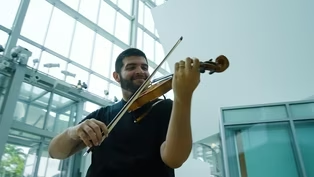
Violinist James Zabawa-Martinez | CHASING CRESCENDOS
Video has Closed Captions
Born in Austin, James knew from an early age that he wanted to play the violin. (10m 50s)
Providing Support for PBS.org
Learn Moreabout PBS online sponsorship(gentle music) ELENI KATZ: When I am about to go on stage, it feels like a point of release, a point of freedom, a point of ready to just let whatever happens happen.
(gentle music continues) (audience applauds) (gentle wind blows) (gentle upbeat music) (gentle upbeat music continues) (gentle upbeat music continues) (zipper zips) The bassoon is a four-foot-seven-inch double reed instrument.
And if you're looking at an orchestra, you will see it's this little white hole that looks like a donut.
And that is the bassoon section.
(bassoon music) Over here we have the reed desk.
I try to make six reeds a week when I'm here at New World.
And these are reeds that I'm kind of cycling through.
I always do a lot of scales.
My neighbors hear m practicing scales all the time.
(bassoon music) This is a tricky little thing for the bassoon.
(bassoon music) So I'm doing a lot of different patterns so I can get my fingers trained.
(bassoon music) (pages rustle) (bassoon music continues) (Eleni hums) I was born in Madison, Wisconsin.
I grew up in a household that really valued creativity.
My mom is an artist and my dad is a doctor.
But on the side he plays jazz piano.
(gentle upbeat music) My mom's best friend from high school lives in Miami, so they're all gonna go to it on Sunday.
In elementary school, all of my friends were taking on their violin lessons and I knew that I wanted to play an instrument, and I didn't want to do what all my friends are doing.
So I actually ended up getting into the band program on clarinet.
A couple years of that went on and I started out pretty close to the front of my section, and then I trickled down until seventh grade, when being in band was no longer cool.
I finally got to the point where “I'm gonna stop, I'm done.” My band director, he comes up to me and says, "Eleni, it's very clear that you love to play "a wind instrument and tha you have something for music."
And then he said, "but you know, it takes someone "really special to play a bassoo "and you will be the only one do And you know, only child, only one doing something.
I'll be special.
Like, maybe this is cooler than going skating at the mall.
I'm gonna give it a shot.
(orchestral music) (orchestral music continues) GEMMA NEW: Great, thank you everyone.
Let's go to the beginning.
Just take a breather.
Because I know it's quite a lot to play in the morning.
For the horns and bassoons, your march one before B was perfect, but we lost it at two after.
You sound so excited about that.
We need that two after B as well (orchestral music) ELENI KATZ: I started to practice yoga my junior year of undergrad.
(gentle music) I started realizing tha things in bassoon playing were actually in a better place when I was practicing yoga.
With playing a wind instrument and with having a yoga practice, both of them all boil down to the breath.
(gentle music continues) In the yoga practice, it's really about trying to be in difficult poses and to keep the breath constant.
(gentle music continues) In music, while you're playing these articulated passages, the things that really produce the sound is having a constant airstream that you know that you can depend on.
(orchestral music) (orchestral music) For the upper strings, wow, you know, you have 250.
(imitating classical instruments) And I've... there were about five people that did it.
And there is many of us on our team.
So we want to make sure we all have that.
So, how about we go right on M?
(gentle music) ELENI KATZ: Bassoonists make their own reeds because the best and worst thing about the bassoon is that you are in charge of how you sound.
And so bassoonists spend a lot of time working on the reed because this is what produces the sound.
(gentle music continues) I have one reed that I'm definitely going to play the concert on, and a backup for the concert.
It's very interesting about how a reed really needs to mature at the right rate before it's ready to play a concert.
(gentle music continues) The thing that's kind of risky is that you can clip a reed, let's say, in the beginning of the week, and think that it has promise, but it might be still a little too wild to play in a rehearsal or for a concert.
It's kind of like taming your stallion and getting it to something that you feel, you feel good and confident that will respond and play in tune with your colleagues.
(tool scrapes) (gentle music continues) So yeah, you can see all this cane coming off.
There's a lot of cane on this reed.
And it's better to have more cane on the reed than less cane on the reed.
It's kind of like hair.
You can't put on more hair after you get a haircut... which sucks.
(Eleni laughs) When I'm a preparing a part, or especially a symphony that has a lot of solo sections, I love to play the bassoon, but I want the audience to kind of forget about the bassoon and just feel like it's voice, someone talking to them.
The obstacles of the instrument do not exist, and it's just, it's someone communicating something.
(box clicks) These are reeds from like concerts that went that I had a fun time playing.
This is a reed I played my first New World concert on, and so that was Mozart Piano Concerto 24.
And then, yeah, this one was I played, when I played with Saint Paul Chamber Orchestra— Mozart Serenade in C Minor.
That was really fun.
A lot of Mozart.
I love Mozart.
It's like a little museum, but this is only probably interesting to bassoonists.
Really nerdy, but whatever.
(reed squawks) (gentle music) I will never get tired of the feeling of creating these particular musical moments with these people, these combinations and things conductors, orchestra members— it's never the same.
We just created this, this, this audience, this is all a particular circumstance that we're all here together.
When everyone stands up after an orchestra concert, like, it is electric energy There's always this moment of, “whew, I made it,” and then you get to share the joy with the audience.
(Eleni laughs) (gentle music continues) (no audio) (gentle music) (gentle music continues) (gentle music continues) (gentle music continues) (gentle music continues)


- Arts and Music
The Best of the Joy of Painting with Bob Ross
A pop icon, Bob Ross offers soothing words of wisdom as he paints captivating landscapes.









Support for PBS provided by:
Major series funding for GREAT PERFORMANCES is provided by The Joseph & Robert Cornell Memorial Foundation, the Anna-Maria and Stephen Kellen Arts Fund, the LuEsther T. Mertz Charitable Trust, Sue...