
TAP DANCING
Clip: Special | 7m 27sVideo has Closed Captions
Patrick Ferreri from New Victory Theater helps students turn sneakers into tap shoes.
Patrick Ferreri from New Victory Theater helps students turn sneakers into tap shoes by taping coins to the soles.
Problems playing video? | Closed Captioning Feedback
Problems playing video? | Closed Captioning Feedback
Let's Learn is a local public television program presented by THIRTEEN PBS
TAP DANCING
Clip: Special | 7m 27sVideo has Closed Captions
Patrick Ferreri from New Victory Theater helps students turn sneakers into tap shoes by taping coins to the soles.
Problems playing video? | Closed Captioning Feedback
Where to Watch Let's Learn
Let's Learn is available to stream on pbs.org and the PBS app.
Providing Support for PBS.org
Learn Moreabout PBS online sponsorship- Hi everyone.
My name is Patrick Ferreri and I'm a dancer actor theater maker and a teaching artist with the New Victory Theater.
Today, we're in my apartment in Brooklyn.
Where were you going to learn to make our own tap shoes.
And then learn a few basic tap steps.
Let's dive in.
To get started we'll have to gather our supplies.
We'll need a pair of shoes, some loose change, tape and a pair of scissors.
I chose these shoes here because they have a nice hard black surface.
We're gonna use the bottoms of our feet or the bottoms of our shoes, the soles of our shoes, to making our sounds today.
So you wanna make sure you have something hard.
Now I have a pair of store-bought tap shoes over here that we can use for reference.
We flip over the bottom of our shoes, we'll notice there are two metal plates, one of the toe and one of the heel.
We're gonna use the coins to mimic these plates.
So to get started, we'll measure out some tape for our stocks.
When I flip over your shoe and find the widest part of your shoe or the ball of your shoe.
Now the ball of your shoe holds the ball of your foot.
And the ball of the foot is what's gonna be used to make our tap sounds today.
So we grab our tape.
Now, here I have packaging tape.
You're welcome to use any kinda tape you want.
I'm like packaging tape because it's a little wider, which means I want to use as much of it.
It's also pretty sturdy.
Since we're gonna be brushing and striking our foot against the ground.
You wanna make sure you use a tape that's not gonna tear too easily.
So you take the tape.
Stretch it again over the widest part of your shoe and then from there, we need a little bit of overhang, we gonna take your scissors and cut a piece.
- [Narrator] Ask a trusted adult for help using scissors.
- Set it off aside this is easy to pick up later.
I've already pre-cut about six pieces of tape.
I recommend putting six to seven pieces as we'll use about three to four pieces for the ball of our foot and another three pieces for the heel.
Once your tape's ready.
[ coins chinkling] Fun part.
And now we get to make a pattern.
We go back to our shoe.
You'll notice the top, toe tap, is almost like a rounded pyramid.
Meaning it starts wider at the bottom and then tapers its way up to the toe.
I'm gonna do that same thing on our shoe.
You wanna start with your widest points.
Now, all of my quarters are being saved for laundry.
So I'm gonna start with some nickels.
I'm just gonna stretch these nickels in a straight line, right across the widest part of my shoe, surrounding up to the edge.
Once I get to the edge, I keep my pattern going, oop.
Run away nickel Coming up the edges.
You wanna go all the way up to the toe.
From there, we'll take our tape.
And again starting at the bottom, you wanna stretch the tape across and then flip those two alleges over.
We'll build our way all the way up the shoe.
All the way up towards the top of the shoe.
When you get to the toe, you can leave a little bit of the tape hanging over.
'Cause we're gonna add one point on the top.
If we go back to our shoes, this metal plate is quite thick, right?
So when we dip our toe into the ground, we also get a sound.
Since our coins are a lot thinner, we want to mimic this by taking one point and placing it right in front, right it big toe.
So you can make that dig sounds later.
You'll take your last piece of tape.
Just cross that point up over the shoe and then wrap it down [mumbles].
From there just give it another little press, making sure all the points are in place.
The tape is nice and sticky on your shoe and voila.
You've got one shoe ready to go.
Next we need to tackle the heel.
We take a look at our Starbucks shoes.
The heel is like a rounded rectangle.
Almost like a big wide horseshoe shape.
We'll also notice that the heels lift a little bit.
So you notice that the heel sort of arcs out and then comes down towards the metal tab.
Now since my shoes that I use are flat, we're gonna mimic that by moving the tap a little bit forward.
So it's not quite the back of the shoe.
It's a little bit in front.
You can measure with your finger.
About a finger width is good or does eyeball it a little about half an inch.
So just like we did at the toe, you wanna start with your wire ones first.
Making a straight line all the way across.
We'll do the same thing with our tape.
Take our last bits of tape, starting at the widest part, pulling over and then building back to the heel.
Just like we gave a little extra coin for the toe tap, we can do the same thing here and take one bigger coin and place it back heel.
So you can do heels taps as well.
Again, you'll wanna secure that across, stretch the edges and fold it down pressing through all the spaces to make sure those points stay nice and in place.
Now I already did one shoe.
So I've got my second sheet ready to go.
And I'm ready to stand up and start learning those moves.
Now that our shoes are ready, it's time to put them on stand up and learn our moves.
We're gonna start with our toe taps and the heel digs.
All we're gonna do is bring our feet next to one another with a little bit of space between them.
Make sure you line your toes front and your heels back.
So that when you bend your knees, its like right over your toes.
From here, all we're gonna do is rock our weight back and forth.
Now you notice just like shifting my weight.
You start to hear a little bit of the sound.
Right now though, the sound of my tape crinkling is a little louder than my taps.
So let's fix that.
To fix that.
You keep your weight back in your heels, flex your toes strong off the ground and tap them down a little bit of force.
Hear how crispy that sound is?
[shoes tapping] You want us to get the hang of that, you can alternate, [shoes tapping] nice little toe taps.
We can up the ante a little bit by adding a balance.
Shifting our weight onto one foot and flexing our leg off the ground.
So quick [shoe tapping] tap.
A little quick [shoe tapping] quick tap on the ground.
Now let you play [shoe tapping] a little bit more speed.
You can also play with the size of the task, right?
So you can tap all of the way round, in little circles.
You can alternate.
[shoes tapping] You can tap.
Nice, now from there, let's do the same thing, with our heels.
Now we're gonna call this a heel dig.
So as we rock our weight on our toes or heels, really dig them into the ground.
Legs up, dig down.
Legs up, dig down.
You can stay nice low.
You can lift your body up, dig it down, lift it up, dig it down.
The options are endless.
We can even try it on one leg.
Lifting up, digging down, digging down, digging down.
Lifting up.
Little speed, little fun, yeah?
Ones you have those, under your belt, practice them as much as you need.
And then you can play with how you want to put them together.
Alternative.
[shoes tapping] You can draw little patterns.
[shoes tapping] There's as many options as there are ideas in your head.
So do go ahead.
Don't be afraid, play around.
Have fun with it.
Tap is as much about showcasing your personality as it is about showing your proficiency with the moves.
How fun would that enjoy your new tap shoes?
I can't wait to see what comes up with.
[shoes tapping]
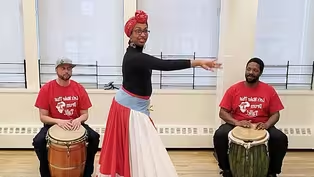
DANCING BOMBA FROM PUERTO RICO
Video has Closed Captions
Barry Blumenfeld from Dance Education Lab introduces students to dancing bomba. (14m 54s)
Video has Closed Captions
Kathryn Lee from the Community-Word Project prompts students to “dance the hands.” (2m 11s)
Video has Closed Captions
Kathryn Lee from the Community-Word Project prompts students to dance the dragon. (2m 14s)
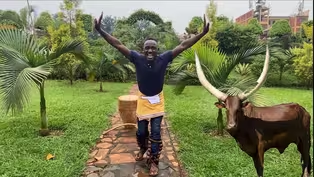
EKITAGURIRO- A DANCE FROM UGANDA
Video has Closed Captions
Barry Blumenfeld from Dance Education Lab and Godfrey teach a dance from Uganda. (15m 9s)
Video has Closed Captions
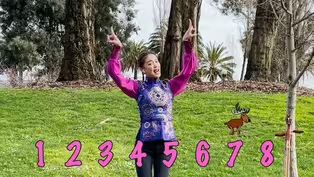
Barry Blumenfeld from Dance Education Lab and Fnu Baigali teach students a reindeer dance. (11m 39s)
Video has Closed Captions
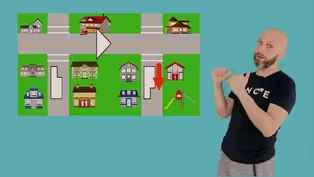
Barry Blumenfeld from the Dance Education Laboratory moves by following a dance map. (13m 47s)
Video has Closed Captions
Barry Blumenfeld from Dance Education Lab leads students to create a jobs dance. (14m 18s)
Video has Closed Captions
Barry Blumenfeld from the Dance Education Laboratory leads students in a cloud dance. (12m 33s)
Video has Closed Captions
Jennifer Eisenberg from the National Dance Institute makes a dance inspired by shapes. (6m 37s)
Video has Closed Captions
Alverneq Lindsay from the New Victory Theater prompts students to do a freeze dance. (1m 25s)
Video has Closed Captions
Fiona Mills from National Dance Institute helps students have fun with body percussion. (6m 5s)
Video has Closed Captions
Ana Nery Fragoso shows students how to dance by turning and balancing. (13m 22s)
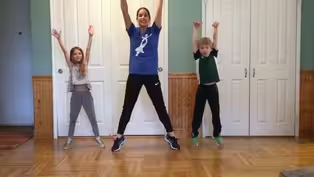
Video has Closed Captions
Emily Meisner from National Dance Institute creates a dance about river creatures. (9m 23s)
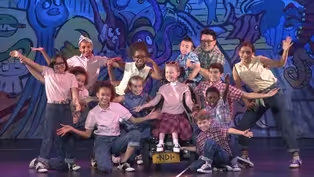
Video has Closed Captions
Students from National Dance Institute perform to “Route 66.” (3m 13s)
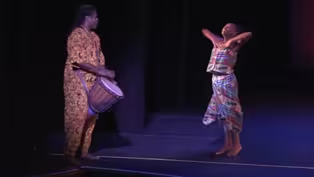
Video has Closed Captions
Exuberant young dancers from National Dance Institute perform “The Drum Speaks.” (6m 47s)
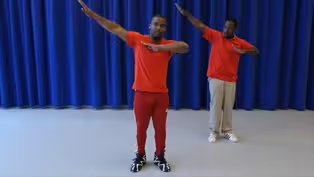
Video has Closed Captions
Hyisheem Calier and Shemar Pelzer from the New Victory Theater step dance. (5m 55s)
Providing Support for PBS.org
Learn Moreabout PBS online sponsorship New Season
- Drama

Hugh Bonneville stars in a crime drama inspired by one of the largest robberies in British history.
 New Episode
- News and Public Affairs

Top journalists deliver compelling original analysis of the hour's headlines.

 New Season
 New Episode




 New Episode
Support for PBS provided by:
Let's Learn is a local public television program presented by THIRTEEN PBS